
For decades, the ritual of the “gym goer” was undisputed. You woke up, packed a bag, drove through traffic, hunted for a parking spot, and navigated a crowded locker room just to wait in line for a cardio machine that may or may not have been wiped down by the previous user. But the landscape of fitness has shifted. We are living in the era of the Home Fitness Revolution, and the indoor exercise bike is leading the charge.
At ExerciseBike.net, we’ve seen thousands of riders make the switch from the commercial gym to the home studio. The reasons go far beyond simple convenience; it’s about metabolic efficiency, financial freedom, and the psychological edge of removing every barrier between you and your workout.
The Financial Reality: Gym Membership vs. Home Ownership
The most common argument against buying a high-end indoor bike is the “sticker shock.” When you see a price tag of $1,500 or $2,000, it feels like a massive hurdle. However, when we perform a Line-Item Audit of a standard gym membership, the math tells a different story.
The True Cost of a Gym
According to industry data, the average mid-tier gym membership in 2026 costs roughly $60 to $120 per month once you factor in “initiation fees,” “annual facility maintenance fees,” and the base monthly rate. If you belong to a boutique cycling studio, those costs can skyrocket to $250+ per month.
Then, there are the “Invisible Costs”:
Gas and Vehicle Wear: If you drive 10 miles round-trip five days a week, you are spending hundreds annually on fuel and maintenance.
Time Opportunity Cost: If the gym commute takes 40 minutes daily, you are “spending” over 240 hours a year just sitting in your car. What is your time worth per hour?
The Break-Even Point
Most premium exercise bikes pay for themselves within 14 to 24 months. After that “break-even” point, your workouts are essentially free, save for the monthly app subscription (usually $15–$44), which is still significantly cheaper than a family gym plan.
Top Contenders: Four Bikes That Beat the Gym
To help you transition, we’ve selected four bikes that represent the best of the current market. Whether you want gamified racing, cinematic landscapes, or “old-school” tank-like durability, there is a model here that outclasses the commercial floor.
1. The Aviron Fit Bike S: The “Gamer’s” Choice
If you find traditional cycling boring, the Aviron Fit Bike S is your solution. Aviron has pioneered the Gamified Fitness niche. Instead of a trainer shouting at you to “dig deeper,” you are participating in high-intensity video games, racing against “bosses,” or escaping zombies. You can read my hands-on review here.

2. The NordicTrack Commercial X24: The Cinematic Powerhouse
The X24 is the “gold standard” for those who want to travel the world. Featuring a massive 24″ HD touchscreen and Incline/Decline technology, this bike physically tilts to match the terrain on the screen. You can read my hands-on review here.
Why it beats the gym: You can’t simulate a 10% grade on a standard gym bike. With iFIT integration, the machine automatically adjusts your resistance and incline, mimicking the French Alps or the hills of Hawaii.

3. The Sole SB900: The “Old School” Tank
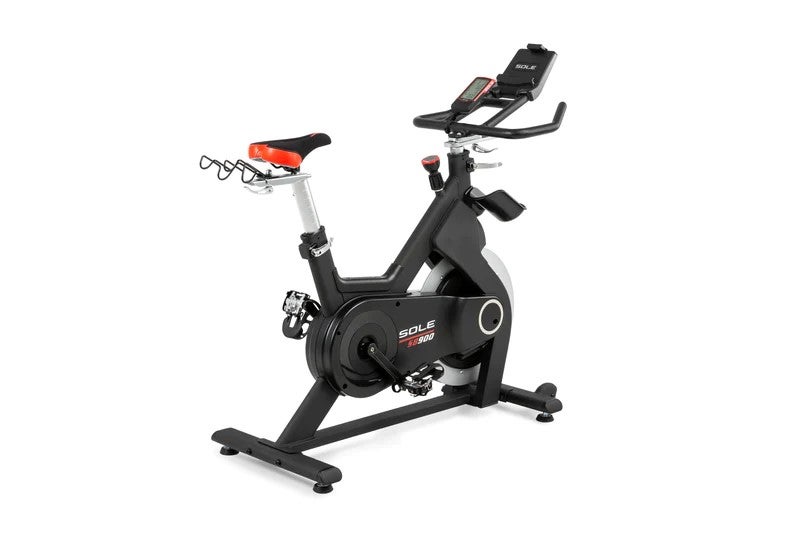
Not everyone wants a touchscreen. Some riders want a bike that will last 20 years and allow them to use their own tablet or watch Netflix. The Sole SB900 uses a heavy 48 lb flywheel and magnetic resistance, offering a ride that feels closer to a road bike than a piece of tech. You can read my hands-on review here.
4. The Echelon EX-5 Smart Bike: The Versatile Value
The EX-5 is the “sweet spot” for many users. It’s compact, incredibly sturdy, and offers a flip-around tablet mount so you can do off-bike strength training or yoga. You can read my hands-on review here.
Comparison Table: Specs, Price, and Value
| Feature | Aviron Fit Bike S | NordicTrack X24 | Sole SB900 | Echelon EX-5 |
| Price (Est.) | See Price $1,299 | See Price $1,999 | See Price $899 | See Price $999 |
| Resistance | Magnetic (16 levels) | Magnetic (24 levels) | Magnetic (Infinite) | Magnetic (32 levels) |
| Display | 22″ HD Touchscreen | 24″ HD Tilt/Pivot | Wireless LCD | None (Use Tablet) |
| Max Incline | N/A | -10% to 20% | N/A | N/A |
| App Fee | $25/mo | $39/mo (iFIT) | Free / $19 (Sole) | $34/mo |
| Best For | Gamers / Variety | Cinematic Scenic Rides | Durability / Simplicity | Studio Style Classes |
The Metabolic Edge: Why Home Workouts Work Better
As a trainer and competitive athlete, I often tell my clients that Consistency beats Intensity. The gym provides intensity, but it often fails on consistency because life gets in the way.
1. Removing “Friction”
Psychologically, the harder it is to start a task, the less likely you are to do it. When your bike is 20 feet from your bed, the “friction” to exercise is nearly zero. You can ride for 20 minutes in your pajamas if you have to. That 20-minute ride is infinitely better for your cardiovascular health than the 60-minute gym workout you skipped because you didn’t have time to drive there.
2. Privacy and Focus
For many, the “Gym-timidation” factor is real. At home, you can fail, sweat, and breathe as hard as you need to without feeling watched. This allows for a higher level of Intensity of Effort, particularly during HIIT (High-Intensity Interval Training).
3. The “Stacking” Effect
Owning your equipment allows you to “stack” your habits. You can catch up on the morning news or listen to a business podcast while you cruise at Zone 2. In a gym, the ambient noise and distractions often make this difficult.
Final Verdict: Is It Worth the Switch?
If you are a self-motivated individual who values your time, the answer is a resounding yes. By choosing a machine like the NordicTrack X24 for its immersive technology or the Sole SB900 for its rugged simplicity, you are making a long-term investment in your health that pays dividends both in your bank account and your heart health.
The commercial gym was a 20th-century solution to a 20th-century problem. In 2026, the best “club” in town is the one located right in your spare bedroom.
Credit: Source link


